

Key Takeaways
- Integration of advanced design software enhances precision and reduces waste.
- Automation in manufacturing improves production speed and consistency.
- Use of engineered wood products increases strength and durability.
- Prefabrication and modular construction streamline building processes.
- Smart trusses with IoT integration enable real-time monitoring.
Wood roof trusses remain a core element in both residential and commercial building projects, evolving in recent years to meet new standards of efficiency, sustainability, and performance. These advancements are reshaping how the construction industry thinks about structural support, offering architects and builders new pathways to both creativity and cost-effectiveness. For companies seeking modern solutions and reliable suppliers, options for wood roof trusses California are evolving rapidly to meet the latest industry standards for strength, digital integration, and sustainability.
As the spotlight increases on productivity, environmental impact, and reliability, recent innovations in trusses are making significant impacts. With the implementation of cutting-edge technology across design and manufacturing, wood trusses are now at the intersection of tradition and innovation, enabling faster builds, less waste, and improved structural safety. Today’s projects benefit from more innovative design development and automated fabrication processes, while supporting green building initiatives aligned with broader climate goals.
Advanced Design Software and Automation
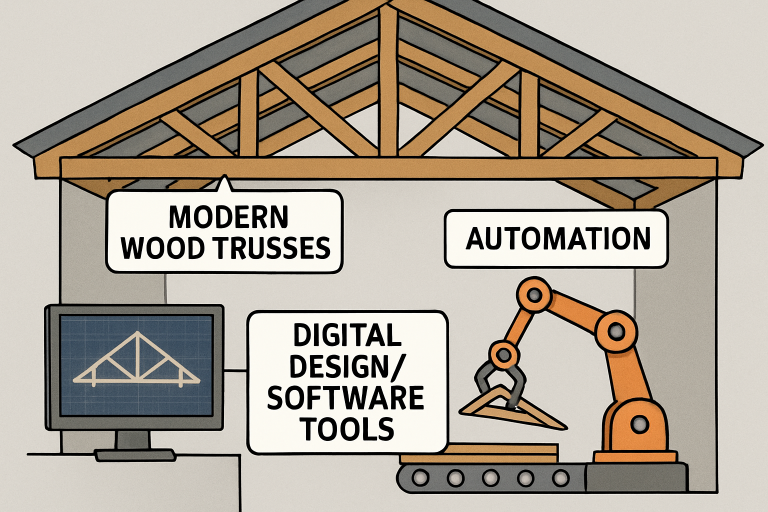
The use of Computer-Aided Design (CAD) and Building Information Modeling (BIM) in wood truss engineering has ushered in a new era of precision. These digital tools enable engineers and designers to create precise models, minimizing material waste and predicting structural performance under a range of conditions. By leveraging these technologies, teams can virtually eliminate errors at both the planning and implementation stages—resulting in faster projects and fewer costly delays. Automation doesn’t end in the design room; manufacturing processes now frequently integrate robotics for cutting, assembling, and finishing trusses. This not only addresses the growing challenge of skilled labor shortages but also yields more uniform products and improved production efficiency. Industry leaders are investing in advanced production lines powered by machine learning and artificial intelligence to predict maintenance needs and optimize workflows.
Engineered Wood Products: Strength and Sustainability
Materials like cross-laminated timber (CLT) and laminated veneer lumber (LVL) offer far greater strength and stability compared to traditional sawn lumber. These engineered wood products are created by bonding layers of wood together under pressure, resulting in strong, lightweight, and versatile components. For large commercial or multi-family builds, these materials provide greater load capacities and longer spans while resisting warping, splitting, or shrinkage that can affect traditional lumber. Significantly, engineered wood also contributes to sustainability goals. Because it uses smaller trees and sometimes incorporates recycled content, this material reduces waste and supports forest stewardship practices, which align with the construction industry’s shifting focus on carbon neutrality.
Prefabrication and Modular Construction
Trusses manufactured off-site and delivered ready to install dramatically increase construction speed while minimizing on-site labor requirements. Prefabrication means that much of the quality control occurs in a controlled facility, where moisture, dust, and inconsistent temperatures do not compromise the wood’s integrity. This translates into trusses that are not only expertly made but also reliably on-spec, reducing delays and expensive rework during installation. Modular and prefabricated wood trusses also help building owners and contractors achieve faster occupancy dates, a key advantage in competitive real estate markets.
Smart Trusses and IoT Integration
The integration of Internet of Things (IoT) technology is forging a new future for smart building systems. Today’s wood trusses can be equipped with embedded sensors to provide real-time feedback on load conditions, structural shifts, and environmental factors, empowering proactive maintenance and enhanced safety oversight. For large projects such as warehouses, arenas, or schools, this means greater peace of mind and the chance to address minor issues before they become major, costly repairs. IoT-enabled trusses also pave the way for more innovative building management systems and can be seamlessly integrated with broader digital infrastructure as the trend towards intelligent buildings continues.
Sustainable Practices in Wood Truss Manufacturing
As green building standards become mainstream, truss manufacturers are adopting eco-friendly production methods. Energy-efficient machinery, on-site solar power, and closed-loop systems for wood waste recycling are all becoming standard practice for leading suppliers. Many companies are also collaborating on reforestation or forest protection initiatives as part of their broader sustainability agenda. Not only do these practices reduce the carbon footprint of building projects, but they also move the entire construction industry closer to meeting international climate targets and securing vital green certifications for builders and property owners.
Conclusion
The wood roof truss industry sits at a pivotal intersection of tradition and technology, spurred onward by advancements in CAD/BIM software, manufacturing automation, engineered materials, and IoT integration. These evolving trends are setting new benchmarks in efficiency, sustainability, and build quality. For construction professionals, homeowners, and architects alike, keeping pace with these trends ensures that structures are not just compliant and safe, but also resilient, innovative, and environmentally responsible.