

Key Takeaways:
- Automakers are increasingly adopting sustainable materials and processes to reduce environmental impact.
- Innovations such as 3D printing and the use of recycled materials are transforming vehicle production.
- Collaborations and regulatory support are crucial in advancing sustainable manufacturing practices.
Introduction
The automotive industry stands at the forefront of a global movement toward sustainability, responding to growing environmental challenges and shifting consumer preferences. Today’s auto manufacturers are reimagining the way vehicles are made, turning to eco-friendly innovations that prioritize both performance and planet. These groundbreaking advancements are setting new standards for resource use and carbon reduction in automotive production. For those interested in how auto manufacturers are shaping a greener future and considering sustainable vehicle options, learn more about the latest developments and local offerings.
Transformation in the sector is driven by innovation and deliberate investment in greener solutions. The use of sustainable materials, new technologies, and collaborative policies makes it easier for carmakers to reduce their environmental impact while meeting regulations and market needs. Consumers also play a key role by supporting responsible manufacturers and circular business models that promote industry change.
Sustainable Materials in Automotive Manufacturing
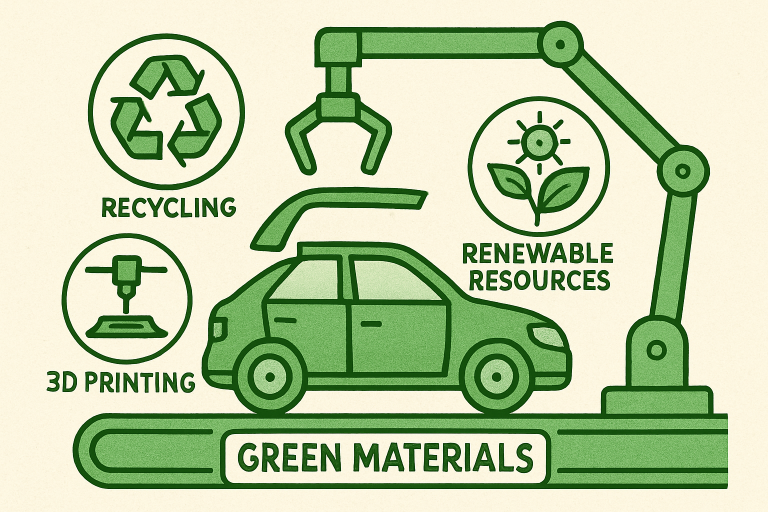
Automakers are adopting sustainable materials to reduce their environmental impact. Traditionally, they used fossil fuel-based plastics and metals, which require significant energy to produce and recycle. However, industry leaders are now using bioplastics, renewable natural fibers, and recycled composites as alternatives. Toyota uses bioplastics from renewable sources in interiors, while BMW uses natural fibers like hemp and flax in door panels. As more manufacturers adopt green sourcing, they are using recycled materials for components like upholstery and underbody shields, reducing greenhouse gas emissions and supporting closed-loop production.
3D Printing and Additive Manufacturing
3D printing is revolutionizing the construction of automotive parts and vehicles by creating complex parts with minimal waste, often using lightweight and recycled materials. Manufacturers are using this technology to build cars from recycled carbon fiber, demonstrating sustainable innovation and advanced engineering. This approach allows for rapid prototyping, efficient small-batch production, and flexible design processes, resulting in less excess inventory and reduced transportation emissions. 3D printing’s efficiency and flexibility can shorten development cycles, allow on-demand customization, and decrease mass storage of parts, accelerating the race towards cleaner and more resource-efficient automotive manufacturing.
As manufacturers experiment with lightweight polymers and additive parts, conventional metal components still play a critical role in vehicle safety and systems where strength and corrosion resistance are paramount. For example, many chassis subframes, exhaust assemblies and fluid lines rely on high-strength, corrosion-resistant tubing; selecting a durable steel tube can extend service life while simplifying recycling at end of life. Because stainless alloys like 400-series balance mechanical performance with recyclability, they complement lightweight strategies by providing durable, repairable connection points. A holistic materials approach recognizes where advanced composites are appropriate and where proven metal solutions still deliver the best lifecycle outcomes.
Recycling and Remanufacturing
The automotive industry is implementing recycling and remanufacturing initiatives to extend the lifecycle of vehicle materials. Closed-loop recycling systems are being integrated at many facilities, allowing automakers to recover and reuse scrap metals, plastics, and glass generated during production. Ford’s use of recycled plastic bottles for underbody shields and a closed-loop aluminum recycling program demonstrates this. These systems support economic and environmental sustainability by limiting landfill growth and conserving finite natural resources. Remanufacturing restores used components to like-new condition, prolonging the utility and value of vehicle parts while minimizing the ecological impact of production.
Regulatory Support and Industry Collaboration
Governmental support is crucial for sustainable progress in the auto sector, with stricter emissions and recycling mandates worldwide. The European Union’s End-of-Life Vehicles Directive mandates that by 2025, 95% of a vehicle’s weight must be reusable or recoverable. This legal framework encourages manufacturers to explore recyclable materials, design vehicles for easier disassembly, and invest in green supply chain solutions. Collaboration between automakers, suppliers, and regulatory bodies is vital for setting common standards, sharing best practices, and fostering innovation. Industry partnerships extend beyond compliance, promoting research and pilot projects for responsible manufacturing methods.
Final Thoughts: Driving Forward Despite the Roadblocks
The road to a fully sustainable automotive industry is not without its challenges—from high development costs and rigorous safety standards to infrastructure gaps and supply chain complexities. Yet, these hurdles are not stopping progress. As technology evolves, consumer awareness grows, and regulations align with green priorities, the momentum toward responsible manufacturing only strengthens. The future of the industry lies in innovation, collaboration, and commitment—ensuring that sustainability becomes a lasting standard that benefits not just manufacturers but consumers, communities, and the planet as a whole.